You do not need a gym membership, fancy machines, or a perfect schedule to get stronger. Beginner strength training at home works because the basics work – consistent effort, simple movements, and a routine you can actually stick with. If you have a little floor space and the willingness to start small, you already have enough to begin.
Why beginner strength training at home is worth it
A lot of people put off strength training because they think they need more experience, more equipment, or more time. In reality, home training removes some of the biggest barriers. You do not have to commute, wait for machines, or feel self-conscious learning the basics in front of other people.
Strength training also does more than help you look more toned. It supports muscle growth, improves balance, helps protect joints, and makes everyday tasks easier. Carrying groceries, getting up from a chair, climbing stairs, and maintaining good posture all depend on strength.
If weight loss is one of your goals, strength training can help there too. Building muscle supports your metabolism and helps your body hold onto lean tissue while you improve your eating habits. That matters because a healthier body is not just about the number on the scale. It is also about function, energy, and resilience.
What you need to start
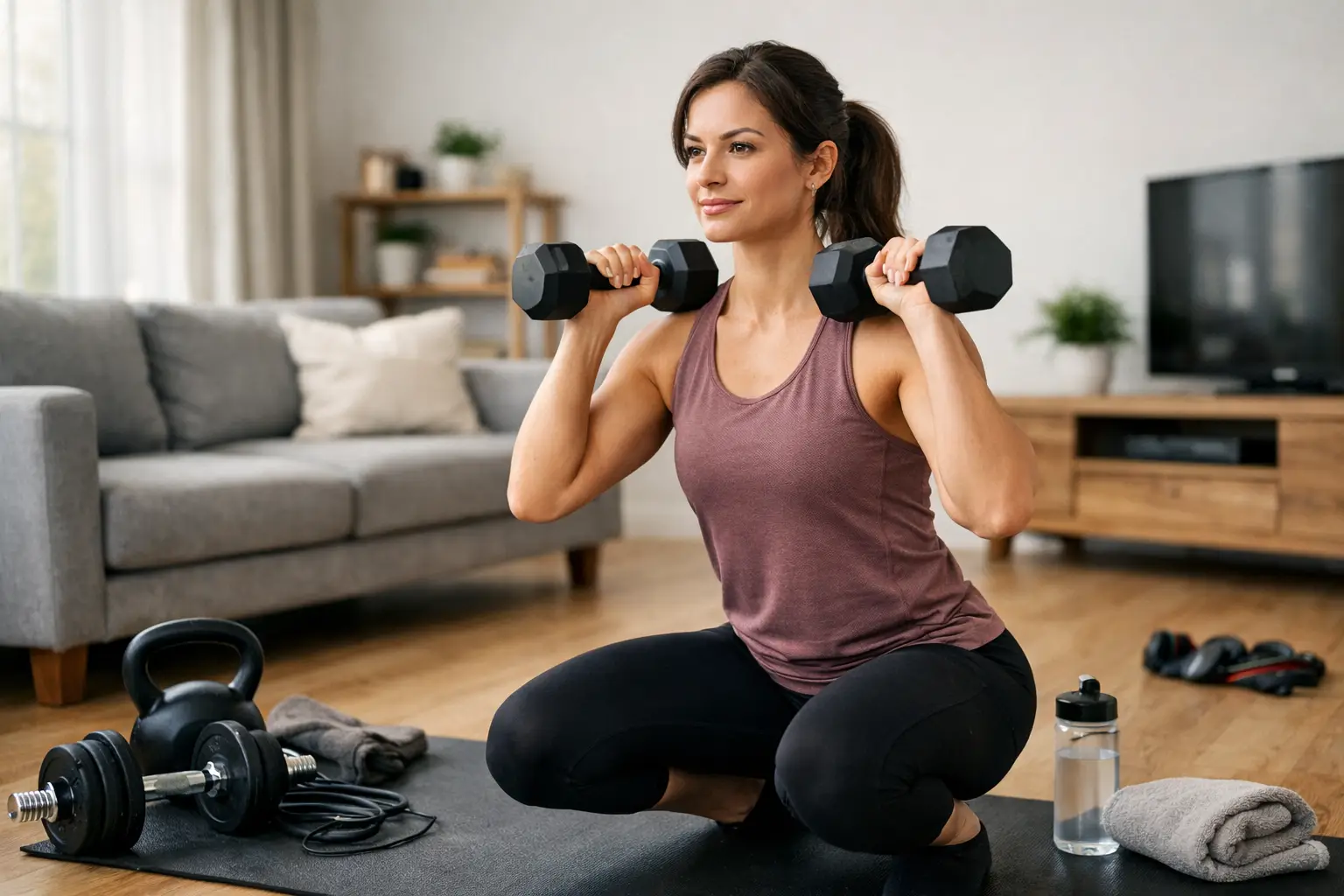
The good news is that you can start with almost nothing. Bodyweight is enough for many beginners, especially during the first few weeks. If you want to add challenge later, a pair of dumbbells or resistance bands can take you much further without taking over your house.
A simple setup includes supportive shoes, comfortable clothing, and a clear area where you can move safely. A yoga mat can make floor exercises more comfortable, but it is optional. What matters most is that your space feels easy to use. If getting started requires too much setup, you will be less likely to stay consistent.
It also helps to set realistic expectations. Your first goal is not to crush a hard workout. Your first goal is to build the habit.
The best exercises for beginner strength training at home
The most effective beginner routines focus on a few basic movement patterns. These train the major muscle groups and give you the biggest return for your effort.
Squat
A squat trains your legs and glutes while also challenging your core. Start by standing with your feet about shoulder-width apart. Push your hips back, bend your knees, and lower yourself as if sitting into a chair. Then stand back up.
If full squats feel hard, use a chair behind you and lightly sit down before standing again. That makes the movement easier to learn and builds confidence.
Push-up
Push-ups train the chest, shoulders, arms, and core. Many beginners do better starting with incline push-ups using a counter, bench, or sturdy table. Wall push-ups are another good option if floor push-ups are too difficult right now.
The goal is not to force the hardest version. The goal is to use a variation that lets you move with control.
Glute bridge
This is a simple but effective move for your glutes and hamstrings. Lie on your back with your knees bent and feet flat on the floor. Press through your heels and lift your hips, then lower slowly.
This exercise is especially helpful if you sit a lot and want to strengthen the back side of your body.
Row
If you have resistance bands or dumbbells, rows are great for your upper back and posture. Bend slightly at the hips, keep your back neutral, and pull the weight or band toward your torso.
If you do not have equipment, you can still train similar muscles with movements like reverse snow angels on the floor, but adding a band is often worth it for this pattern.
Overhead press
With light dumbbells or bands, press the weight from shoulder height up overhead. This strengthens the shoulders and arms. Keep your ribs from flaring too much and avoid leaning back.
If overhead pressing bothers your shoulders, it may be better to focus on push-ups and rows first, then revisit this move later.
Plank
Planks train your core without requiring a lot of movement. Start on your forearms or hands and hold your body in a straight line. Short, high-quality holds are better than long, sloppy ones.
For beginners, even 10 to 20 seconds can be enough.
A simple routine you can follow
You do not need a complicated split routine when you are starting out. A full-body plan done two to three times per week is usually the smartest place to begin. That gives your muscles enough practice without overloading your schedule.
Try this structure:
- Squats – 2 to 3 sets of 8 to 12 reps
- Incline or wall push-ups – 2 to 3 sets of 6 to 10 reps
- Glute bridges – 2 to 3 sets of 10 to 15 reps
- Rows with bands or dumbbells – 2 to 3 sets of 8 to 12 reps
- Overhead press – 2 sets of 8 to 10 reps
- Plank – 2 to 3 rounds of 10 to 20 seconds
Rest about 45 to 90 seconds between sets. If that feels like too much at first, start with one set of each exercise and build from there. A routine that looks easy on paper but gets done every week beats an ambitious plan you quit after four days.
How hard should your workout feel?
This is where many beginners get confused. You do not need to feel destroyed after a workout for it to count. In fact, going too hard too soon is one of the fastest ways to end up sore, discouraged, or injured.
A good beginner set should feel challenging by the last few reps, but you should still be able to keep solid form. Think of it as finishing a set knowing you could maybe do one or two more reps if you had to. That is enough to make progress.
If an exercise feels too easy, slow it down, add reps, add another set, or use more resistance. If it feels too hard, reduce the range of motion, pick an easier variation, or lower the weight. Progress is not about suffering. It is about gradually asking your body to do a little more over time.
Common mistakes that slow progress
One common mistake is changing workouts constantly. Variety can be fun, but beginners usually get better results from repeating the same basic movements for several weeks. Repetition helps you improve form and clearly see your progress.
Another mistake is ignoring recovery. Muscle gets stronger after training, not just during it. Sleep, hydration, and enough protein all matter. If your body feels run down all the time, more workouts are not always the answer.
Some people also focus too much on motivation. Motivation comes and goes. A better strategy is to make your workouts simple enough that you can do them even on a low-energy day. Healthy Survive often emphasizes manageable habits for a reason – consistency usually beats intensity.
When to add equipment
You can get a strong start with bodyweight, but there may come a point when exercises stop feeling challenging. That is a good sign, not a problem. It means your body is adapting.
At that stage, resistance bands are often the easiest and most affordable upgrade. They are useful for rows, presses, squats, and glute work. Adjustable dumbbells are another solid option if you want more room to progress over time.
You do not need a full home gym. A small amount of equipment used well is enough for most beginners for quite a while.
How to stay consistent when life gets busy
The best home workout plan fits real life. That means choosing days and times you can actually protect. For some people, that is 20 minutes before work. For others, it is after dinner three nights a week.
It also helps to stop thinking in all-or-nothing terms. If you miss one workout, do the next one. If you only have 10 minutes, do one round instead of skipping it. Strength builds through repeated effort, not perfection.
Tracking your workouts can help more than you might expect. Write down your reps, sets, and exercise variations. Seeing that you moved from wall push-ups to incline push-ups or from bodyweight squats to goblet squats is real progress, even if the mirror takes longer to show it.
Beginner strength training at home can grow with you
What starts as a few simple exercises in your living room can turn into a lasting health habit. As you get stronger, you can add resistance, improve technique, and increase training volume. But you do not need to figure out all of that right now.
Start with the version you can do today. Learn the movements. Stay patient through the awkward first couple of weeks. Strength is built one session at a time, and your home is more than enough place to begin.
A strong body is not built by waiting for perfect conditions. It is built when you decide that small, steady action counts – and then prove it to yourself again this week.